
Strategic branding for semiconductor companies (beyond the spec sheet)
Semiconductor brand strategy for a buyer who already knows the physics: numbers first, compliance as proof, and names that survive the next node.

- A spec sheet proves performance, not a company. The buyer list is a few dozen system architects who already know the physics, so reach is worth little to them.
- The advantage usually lives in a number: energy per bit, area, yield. Specialists trust those figures before any tagline, so they belong where they are easiest to read.
- The span from first meeting to design win is long enough for a process node change. A brand built around today's part ages before the revenue arrives.
- Naming has to hold the company, the product family, the IP core and the interface, with room for the part that has not taped out yet.
Strategic branding for a semiconductor company is the work of deciding what the brand claims once the spec sheet has already done its job. A spec sheet proves performance. It does not prove a company, and the distance between those two facts is where a system architect's trust actually gets decided.
Why does a strong spec sheet fail to establish a company?
A strong spec sheet fails to establish a company because it answers one question and the architect is asking several. The spec confirms that a part hits a stated bandwidth or power number. It cannot confirm that the company will still ship the part in three years, support the next node, or pick up the phone two years into a design-in.
Most semiconductor brands stop exactly where the spec sheet stops. The architect's remaining questions go unanswered on the page:
- Will this part still be in production when our product ships?
- Is there a roadmap to the next node, and who owns it?
- Who do we call when the silicon misbehaves on our board?
There is also little to show beside the spec. A packaged die is a black rectangle, and almost everything worth buying happens inside it. Photography cannot show an interconnect, a signal path or a thermal profile.
That is why so many semiconductor sites fall back on glowing circuit patterns and stock wafers. The better option is to model what a photograph cannot capture: the die, the interposer and the interconnect, built from the company's own drawings.

Why is the buyer list so small, and why does reach not help?
The buyer list is small because a fabless or IP company may have a few dozen real customers worldwide. All of them are system architects who already understand the physics. No volume of impressions substitutes for being credible to that handful of people.
Our semiconductor branding work builds the brand for that room specifically. The room usually holds three comparisons at once:
- The IP vendors selling a similar block.
- The large incumbents, whose name alone lowers perceived risk.
- The customer's own in-house team, asked whether it could build the block instead.
The third comparison rarely appears in the brand, yet it is often the real alternative. Against an incumbent, the case is usually a specific number the incumbent has stopped improving. Against an in-house team, the case is time and risk, and raw performance matters less.
Why do the numbers matter more than any tagline?
The numbers matter more because the differentiation in this category lives in energy per bit, die area and yield. An architect reads those before a single sentence of positioning copy. Many agencies cut dense technical tables because they look dry next to photography, which removes the evidence a specialist came for.
Technical credibility and design quality can sit on the same page. The discipline is making the numbers the easiest thing on the page to read and compare.
The person writing that story should be able to read the numbers too. That sounds like a low bar, and a surprising number of technical brand engagements fail to clear it. We cover the same principle for adjacent hardware in our electronics and photonics branding guide.
Are interface standards just table stakes?
To an architect, interface standards are table stakes, and that is exactly why they matter to everyone else in the room. PCIe, CXL and UCIe compliance sound like commodity checkboxes. Framed properly, they prove the part can ship into someone else's silicon on schedule.
Each standard has a public way to check the claim:
- The CXL Consortium lists products that passed its compliance testing on the CXL Integrators List.
- The USB-IF tests USB4 products against a published compliance matrix.
- UCIe describes itself as "building an open ecosystem of chiplets for on-package innovations".
- OIF runs interoperability demonstrations for optical and electrical interfaces, including co-packaged optics.
An investor or a generalist cannot evaluate the engineering directly. A named listing on a consortium's own page is evidence they can use.
Who has to agree, the architect or the investor?
Both have to agree, and they read the page for opposite reasons. The architect wants the eye diagram: the detail that lets them verify a claim against their own conditions. The investor wants the market: category size, comparables and a growth story they can underwrite.
Public money now sits behind that growth story. The US CHIPS and Science Act allocated $50 billion in 2022 to semiconductor research and manufacturing. The European Chips Act, in force since 21 September 2023, aims to "reinforce the semiconductor ecosystem in the EU".
A brand written only for the architect reads as an engineering document with no case for the business. Written only for the investor, it reads as a pitch deck no engineer will trust with a design-in.
The answer is one page with two clearly separated paths, one for each reader. We cover how to write for both in talking to investors, buyers and engineers.
What happens when the design cycle outlives the brand?
The brand ages before the revenue arrives. The span from first meeting to design win is long in this category, often long enough for a process node change in the middle. An identity built tightly around today's part describes a product that has moved on before the deal closes.
The industry plans on long horizons too. The IRDS, the IEEE's device and systems roadmap, forecasts developments across a 15-year horizon.
So build the brand around the company and the family. A single product breaks its own brand at the second tape-out if the identity only ever described the first one.
A part can change generation. A company should not need to.
What does naming need to hold across a semiconductor product line?
A semiconductor naming system needs four layers, with room for a part that has not taped out yet:
- The company.
- The product family.
- The individual IP core.
- The interface it supports.
Naming a chip after its first application is a common mistake. The second design win is rarely the same application, and a name built for one use case reads as a mismatch the moment it is reused.
The company name has to sit clearly above all of it. A buyer evaluating a die, an IP core and an interface variant in one meeting should see at a glance that all three come from one accountable company. Our naming work builds that hierarchy before the first part ships.
What did the Kandou AI engagement actually involve?
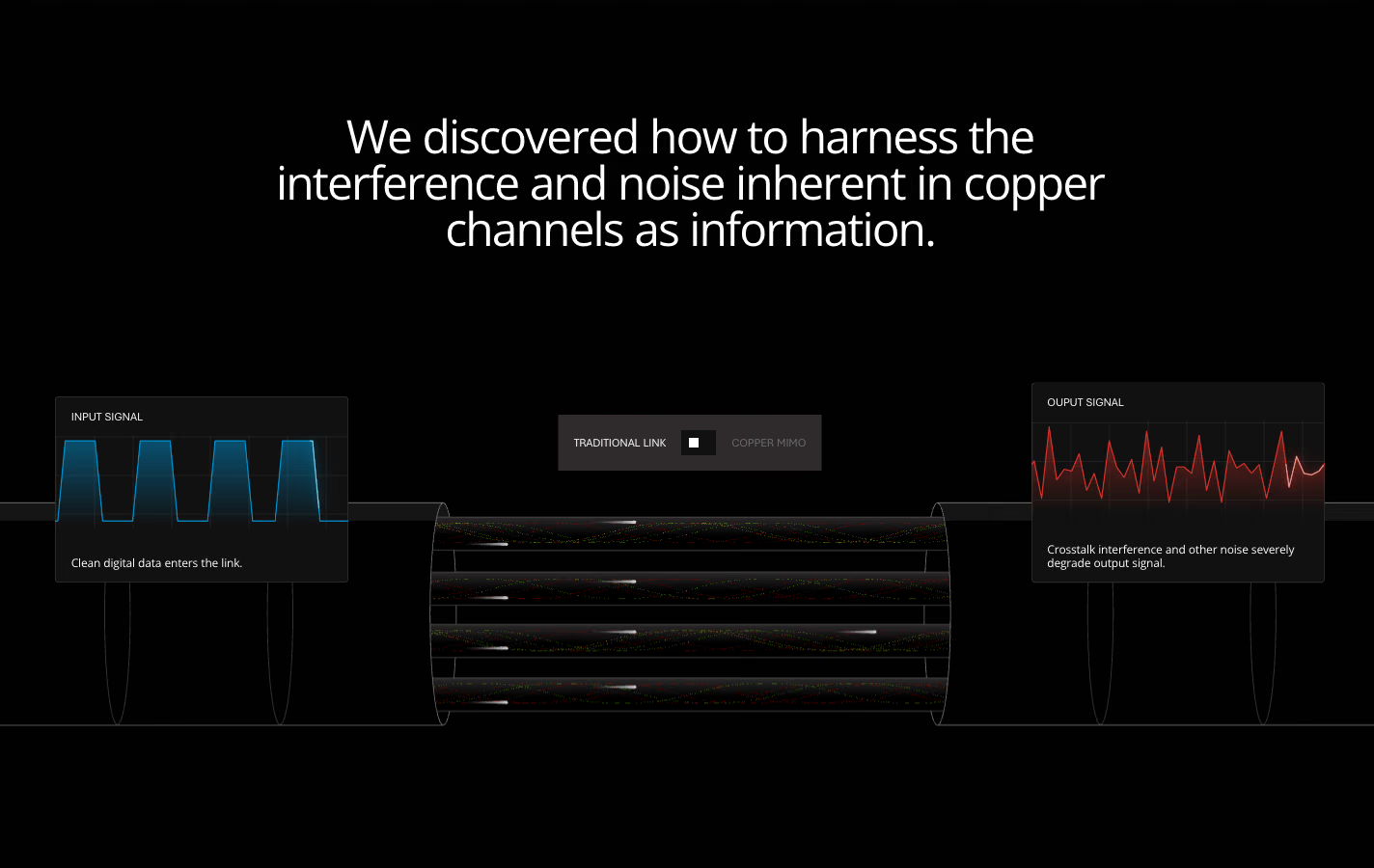
The Kandou AI engagement covered brand, 3D and a Webflow build for a Swiss fabless semiconductor company. Kandou ships PCIe and USB4 retimers, CXL controllers, co-packaged optics and Copper MIMO interconnect.
Kandou's case study describes the result as an experiential website across four markets: inference, training, CXL memory and rack connectivity. Each market has its own audience and its own reason to be on the page. That outcome is reported by the client, not measured by us.
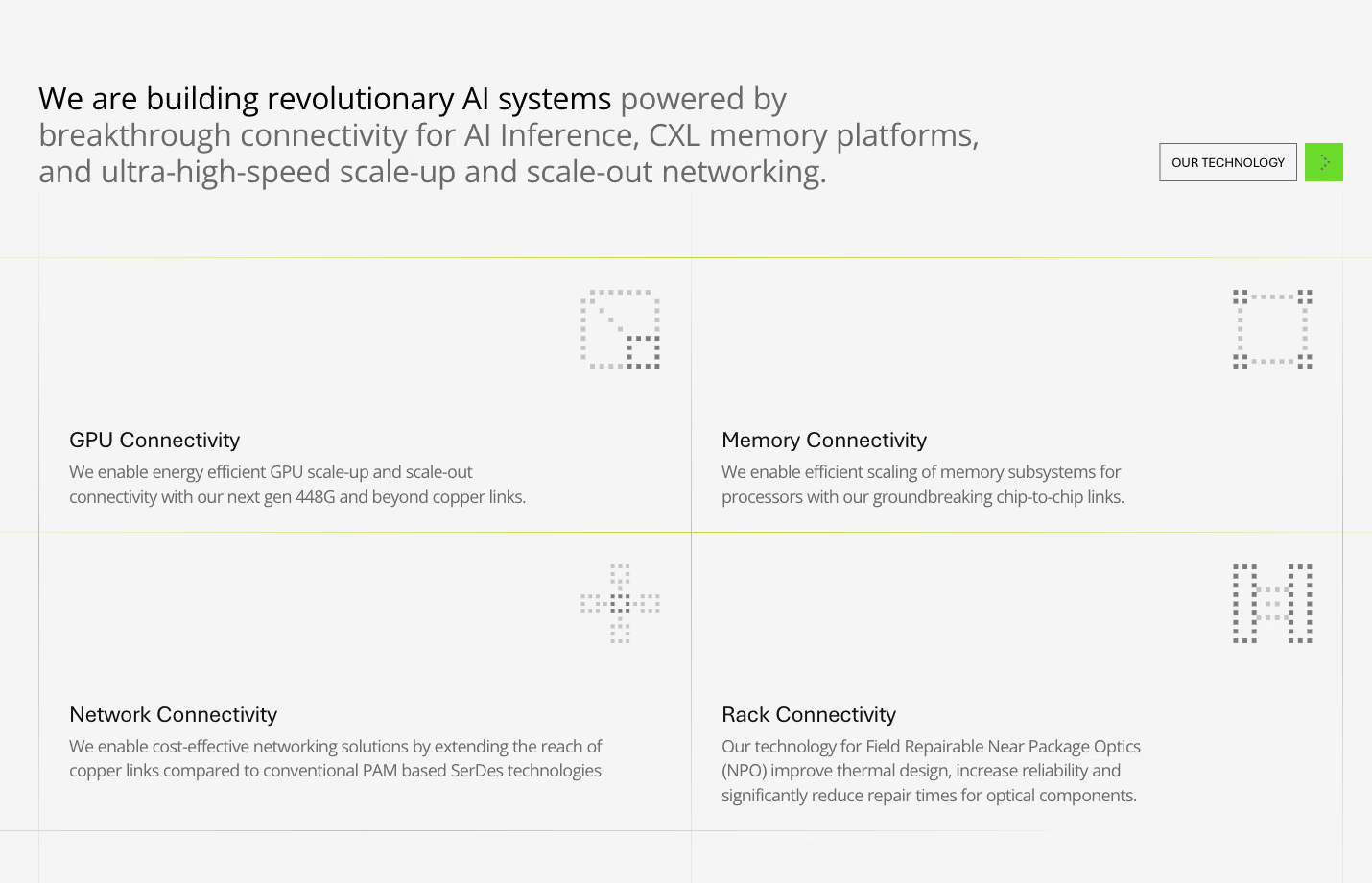
The identity had to hold across four product conversations without reading as four companies. That is this category's naming and positioning problem in its most concentrated form.
What does an engagement deliver, and how long does it take?
A semiconductor brand engagement takes nine to sixteen weeks from kickoff to a finished brand system, at a fixed scope and one price. The price is quoted after a thirty-minute call, and the ranges are on our pricing page.
The work runs in this order:
- Category and positioning: IP vendor, fabless product company or chiplet supplier. The label decides the comparables.
- Naming.
- Narrative and identity.
- Messaging for each audience.
- A brand book that records all of it.
The team is nineteen people, ten of them engineers by degree, across strategy, 3D, delivery and build. We sign an NDA before reviewing unannounced silicon, and that is our normal starting point.
Most of what makes a semiconductor company defensible has not taped out yet, and positioning has to be able to touch the roadmap. More on how that works in branding under NDA.
When is this not a fit?
A quick logo refresh or a single product page is not a fit. A freelance designer will do that faster and for less, because it needs no category decision and no naming system built to survive several nodes. If only the site needs work, our semiconductor website practice is the narrower option.
Branding also cannot bridge a gap between the technology and the claims. If the business side wants to say more than the engineering currently supports, fix that first.
This suits a company willing to have both conversations on the same page, with engineering and commercial in the same room while the positioning gets decided. A company that wants the investor story to outrun the engineering should look elsewhere.
FAQ
Do you work with fabless companies, IP vendors or both?
Both, along with chiplet and advanced packaging companies. The problem is the same in each case: the advantage sits in numbers a specialist trusts and a generalist cannot read without help.
Have you done this before?
Yes. Kandou AI, a Swiss fabless semiconductor company working on PCIe and USB4 retimers, CXL controllers, co-packaged optics and Copper MIMO interconnect. Also Cuzor, on GaN charger internals, which sits closer to electronics than semiconductors but shares the same design-in logic.
Do you do naming as well as identity?
Yes. Company, product family, IP core and interface names, built as a system that still works at the next process node without a rename.
Do you sign NDAs before seeing the roadmap?
Yes, and it is the normal starting point. Most of what makes a semiconductor company defensible is unannounced silicon.
When should a semiconductor company hire someone else?
When the need is a quick logo refresh or one product page, or when the business story is running ahead of what the engineering can currently support.
Written by Mejo Kuriachan. More in the blog, the glossary and the FAQ.