
Strategic branding for advanced manufacturing companies (at volume)
Advanced manufacturing brand strategy for qualification: evidence that holds at volume, certificates buyers can check, one site for plant and procurement.

- A capability list proves what the equipment can do once. Qualification asks whether the result holds across shifts, batches and a full contract.
- Two buyers read the same page. The plant checks tolerance and repeatability; procurement checks capacity, lead time and single-source risk.
- AS9100 and IATF 16949 certificates can be checked online by any buyer. Stated with scope and site, they become evidence.
- Sevenloop, build-to-print metal parts on an AI-assisted manufacturing platform, is our client in this category.
Strategic branding for an advanced manufacturing company is the work of deciding what the brand claims once the tolerance has already been measured. A capability list proves what a machine can do on a good day. It does not prove the company can hold that result at volume, across a shift change, for the length of a contract, and that second claim is the one a qualification process is actually built to test.
Why does a capability list fail to win the qualification?
A capability list fails because it shows one good part, and qualification scores whether you can hold that result at volume. A single measured sample shows the equipment can do the job under controlled conditions. A buyer qualifying a supplier wants proof the result survives tool wear, operator changes and material lot variation.
Our advanced manufacturing branding work treats that gap as the brief. The real question is whether you can keep making the part after the fifth changeover. A brand that only shows its best sample invites the question it cannot yet answer.
Buyers check capability claims against formal evidence, because the supplier chose which sample to measure. The usual evidence set:
- A first article inspection, which in aerospace follows the AS9102 requirements.
- Process capability data. The NIST/SEMATECH handbook defines capability as comparing an in-control process to its specification limits, using indices such as Cpk.
- For automotive parts, a PPAP submission, which demonstrates that the supplier's manufacturing process meets the design records and specifications.
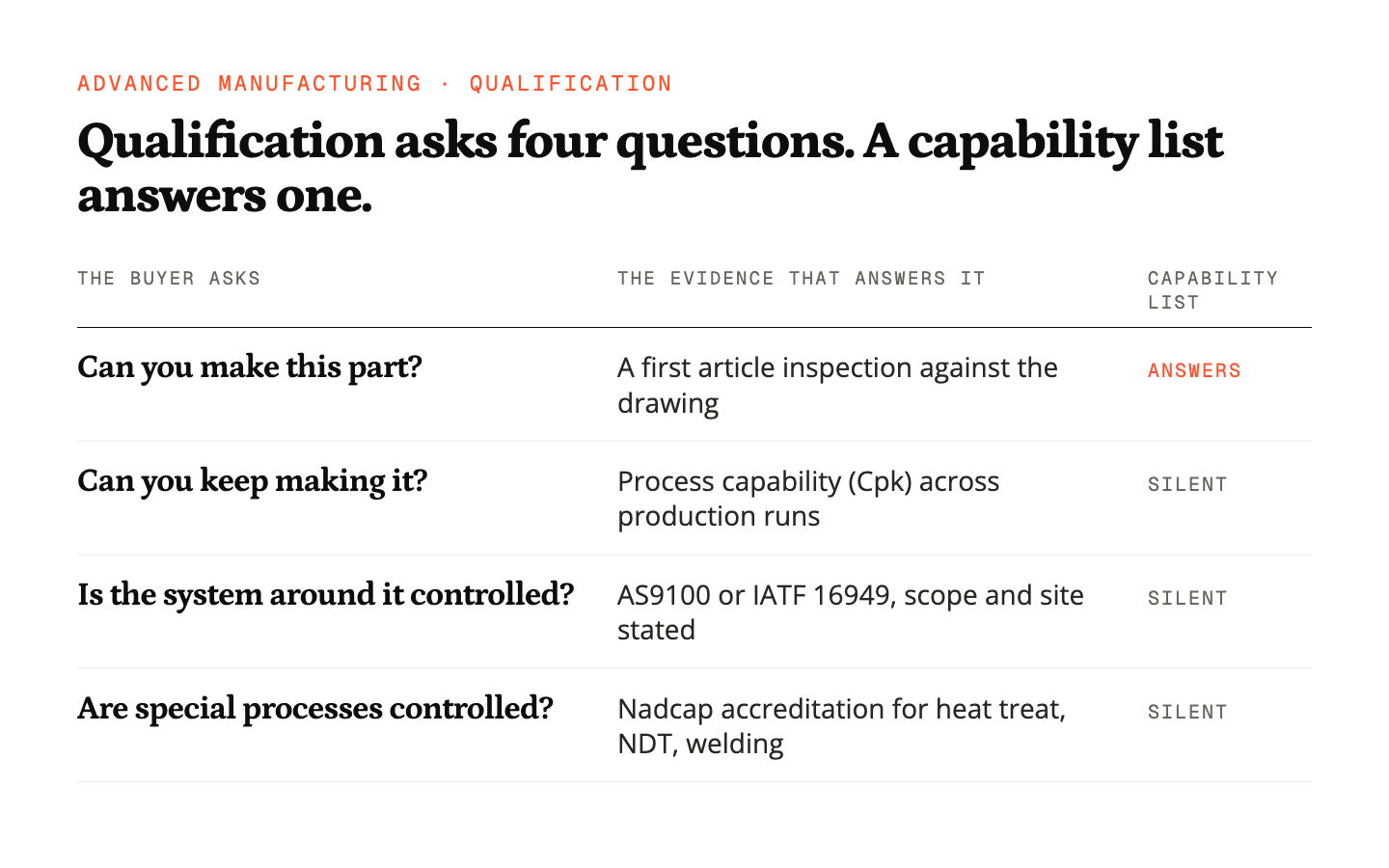
Additive parts face a steeper version of the same test. NIST reports that qualifying them currently takes thousands of tests, millions of dollars and several years, and that minor process changes require complete re-qualification.
Branding cannot replace that evidence. It can organise it, so the data a buyer needs is easy to find and consistent in every document that carries the company name.
Who actually decides whether you get qualified, the plant or procurement?
Both decide, and each is checking for a different failure. The plant engineer fears the part drifting out of tolerance once the trial run ends. Procurement fears depending on one supplier for a part the line cannot run without.
- The engineer reads tolerance, repeatability and first-pass yield against their own drawing, and wants a way to verify each figure.
- Procurement reads capacity, lead time and price stability, and asks what a second source would look like.
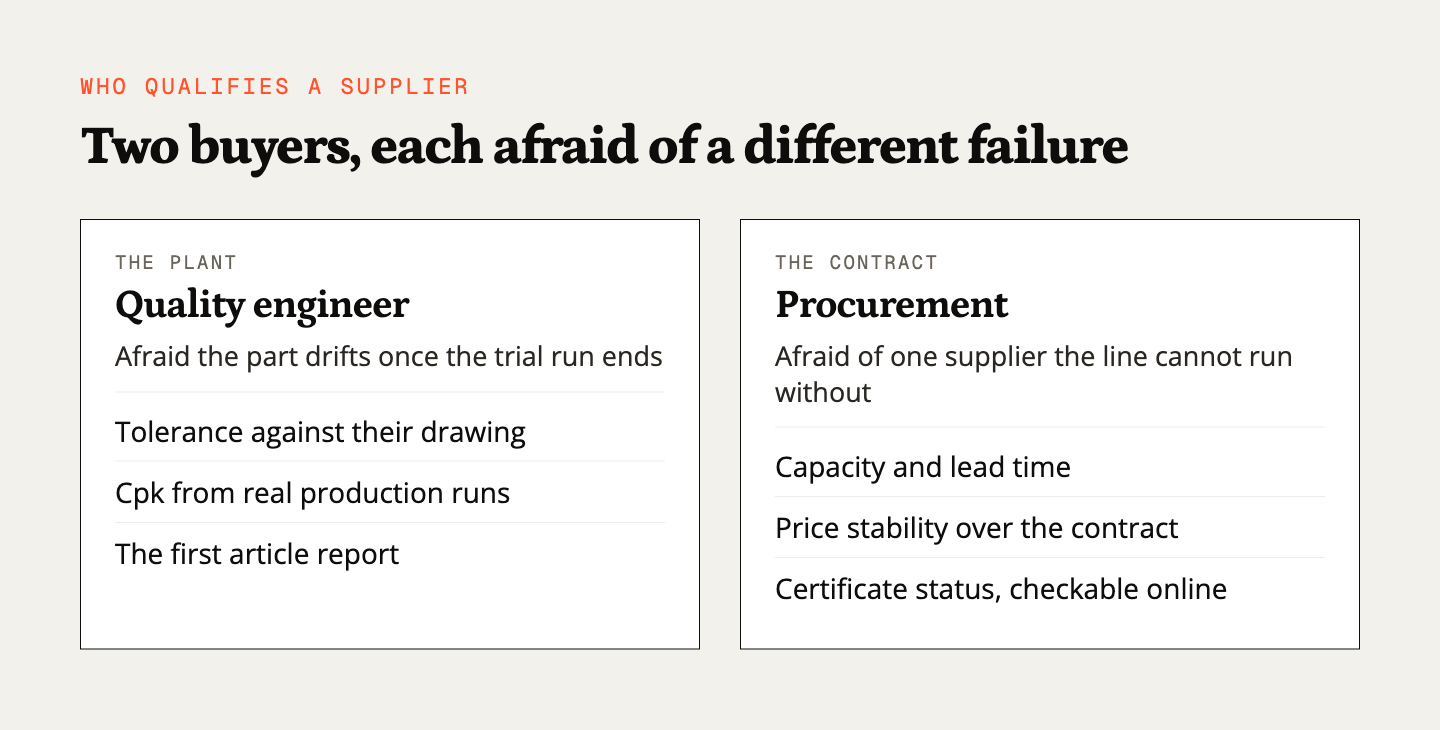
Most manufacturing sites write for the engineer alone, because the engineer asks the questions on a plant visit. Procurement gets a contact form. A brand system gives both functions a path through the same site.
Aerospace suppliers meet the same split with defence procurement added. We cover that sector in its own guide.
Why does the word "precision" now convince nobody?
"Precision" convinces nobody because almost every competitor uses it with no number attached. Buyers read past it within a sentence. The word "advanced" suffers the same fate in materials marketing, which we cover in our advanced materials guide.
The evidence that still works is a number stated plainly enough to compare:
- tolerance in microns, against a named feature
- repeatability across a stated number of parts
- first-pass yield on a production run
- Cpk, with the run it came from
Generalist agencies often cut these tables, because dense figures look uninviting beside a factory photograph. That table is what the engineer came to find. Without it, a site looks like it has nothing to show.
A capability table can carry the brand's type, colour and hierarchy and still be the fastest thing on the page to read. Evidence that is rigorous and legible is most of what separates a manufacturing brand from a catalogue.
Should a certification such as AS9100 or IATF 16949 live in a footer or carry the story?
A certification should carry the story, because buyers can check it and most competitors bury it. AS9100 is the quality management standard for aviation, space and defence organisations, and IATF 16949 is its automotive counterpart. Both certify the system around the part.
Buyers do not have to take the logo on trust. Aerospace certificates sit in the IAQG's OASIS database, and the IATF runs a certificate validity check. A logo strip in the footer sends the buyer off to look it up alone.
State three things beside each certificate:
- Which standard, and which revision.
- Which scope it covers.
- Which facility holds it.
Special processes need the same treatment. Nadcap accredits critical processes such as heat treating, non-destructive testing and welding, so a supplier that holds it should name the process and the site. Security vendors face the same test with SOC 2 and ISO 27001, which we cover in our cybersecurity guide.
Certification does not replace part-specific evidence. It tells a buyer the system around the part is controlled. The two claims belong side by side.
How do you brand a company whose real asset is a tolerance nobody outside the plant can picture?
Connect the tolerance to what it lets the customer's product do. A tolerance of a few microns means nothing to a procurement lead reading quickly. What it does to their assembly, failure rate and warranty cost is the sentence that gets read.
Photography struggles here, because a precision part often looks like any other part. Custom 3D earns its place: a modelled cross-section or an animated tolerance stack shows the difference the number makes on the finished assembly. We explain when that is worth the cost in 3D industrial animation for deep tech companies.
The evidence also has to survive someone else's internal review. A procurement lead forwards supplier data into their own qualification file. Evidence that stands on its own strengthens their case; evidence that needs a phone call becomes a reason to pick someone else.
What does Sevenloop show about branding a manufacturing platform?
Sevenloop shows that the real positioning question is often platform or job shop, and that a platform needs its own evidence. Sevenloop builds build-to-print metal parts on an AI-assisted manufacturing platform. We built its branding, website, film and 3D around that distinction.

The site steps a buyer through the solutions by stage, so the platform reads as a process they can follow.
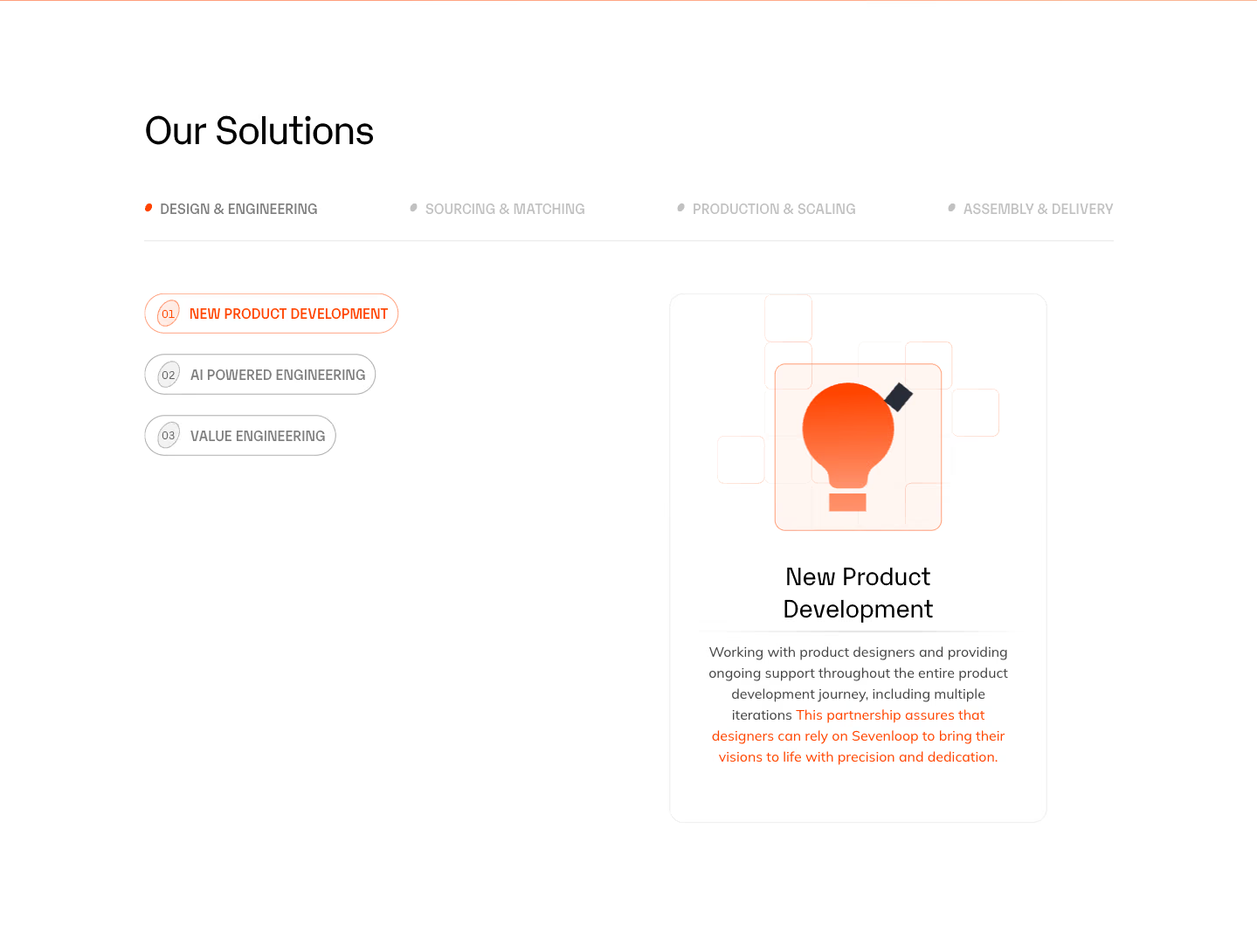
We have not published a business outcome for this engagement. What the work shows is the mechanism. When a company's advantage sits partly in software and process, the brand has to make that visible, or a buyer scanning quickly assumes one more precision shop.
What does naming need to survive when a second facility is on the roadmap?
Naming needs a structure that keeps company, process and equipment line apart, because any one of them can multiply while the others stay fixed. A name built around one process, machine or site reads as a limit the day a second facility opens.
Define the layers before naming a single line:
- The company.
- The process family.
- The individual line or cell.
That gives a new facility or capability a logical place to sit, without a rename or an awkward sub-brand. It matters more here than in most categories, because stamped parts, nameplates and certificates outlive the marketing site. Our naming work starts from that structure.
What does an engagement deliver, and how long does it take?
An advanced manufacturing brand engagement takes nine to sixteen weeks from kickoff to a finished brand system, at a fixed scope and one price. The price is quoted after a thirty-minute call, and the ranges are on our pricing page.
The work runs in this order:
- Category and positioning, against low-cost suppliers, incumbents and the customer's own in-house capability.
- Naming, where the structure needs it.
- Narrative and identity.
- Messaging for the plant, procurement and leadership.
- A brand book with usage rules that hold after we leave.
The team is nineteen people, ten of them engineers by degree, across strategy, 3D, delivery and build. That matters in a category where a rendered cross-section explains more than a photograph.
We sign an NDA before reviewing unpublished process detail, because a manufacturing company's process is often its real moat. We explain how that works in branding under NDA.
When is this not a fit?
A quick logo refresh or a single product page is not a fit. A freelance designer or a production studio will do that faster and for less, because it needs no positioning decision and no naming structure. If only the site needs work, our advanced manufacturing website service is the narrower option.
If the plant and procurement cannot both be in the room, wait. The plant holds the tolerance and process evidence; procurement holds pricing, capacity and continuity. A brand built from one side will promise something the other side cannot approve.
This suits a company willing to put positioning, naming and evidence on the table together. A company that wants new graphics over an unclear capability story should look elsewhere.
FAQ
How long does an advanced manufacturing branding engagement take?
Nine to sixteen weeks for positioning, narrative, identity and a brand book, at a fixed scope and one price agreed after an initial call.
Have you worked with an advanced manufacturing company before?
Yes. Sevenloop builds build-to-print metal parts on an AI-assisted manufacturing platform, and we built its branding, website, film and 3D. We have not published a business outcome from that engagement.
Does branding replace a first article inspection or a process audit?
No. Branding does not prove a part meets a drawing. It organises the evidence so a buyer can find it, check it and compare it, with the detail an engineer or auditor needs intact.
Should AS9100 or IATF 16949 be featured on the site or left to the sales process?
Featured, and stated precisely: which standard, which scope, which facility. A logo with no detail behind it answers nothing when a buyer checks it against their own audit requirements.
When should an advanced manufacturing company hire someone else?
When the need is a quick visual refresh or a single page, or when the plant and procurement cannot both take part in the positioning and evidence decisions.
Written by Mejo Kuriachan. More in the blog, the glossary and the FAQ.