
Strategic branding for robotics companies (payback first)
Robotics brand strategy for buyers costing an installation: payback before motion, autonomy stated at the level you ship, integration cost up front.

- Robotics marketing sells motion. Robotics buyers are costing an installation. Most robotics brands lose the deal in the gap between the two.
- A robot purchase usually carries two signatures. An engineer checks whether it works in their conditions, and a budget holder checks when it pays back.
- Autonomy claims are the fastest way to lose a technical buyer. Say the level you ship and what a human still does.
- The buyer is modelling integration cost whether you mention it or not. Put a realistic deployment picture in the brand, early.
Strategic branding for a robotics company is the work of deciding what the brand claims when the demo video stops. The video always works. What decides the purchase is integration cost, cycle time against the current process, and how long the payback takes, and almost none of that is in the average robotics brand.
Why do robotics brands fail more often than the engineering does?
Robotics brands fail because the marketing sells the moment of motion while the buyer is building a spreadsheet.
A robot arm moving smoothly is impressive, and every competitor has the same video. The International Federation of Robotics counted 542,000 industrial robots installed in 2024, more than double the number ten years earlier. A buyer choosing among that many machines has seen plenty of motion.
What no demo video shows is the part the buyer is costing:
- what it takes to put the robot into their line
- what it does to throughput
- what happens when conditions differ from the video
Our robotics branding page puts it as plainly as we can: a working demo does not establish payback.
Who actually signs off on a robot purchase?
Two people sign off on a robot purchase, and they want different things.
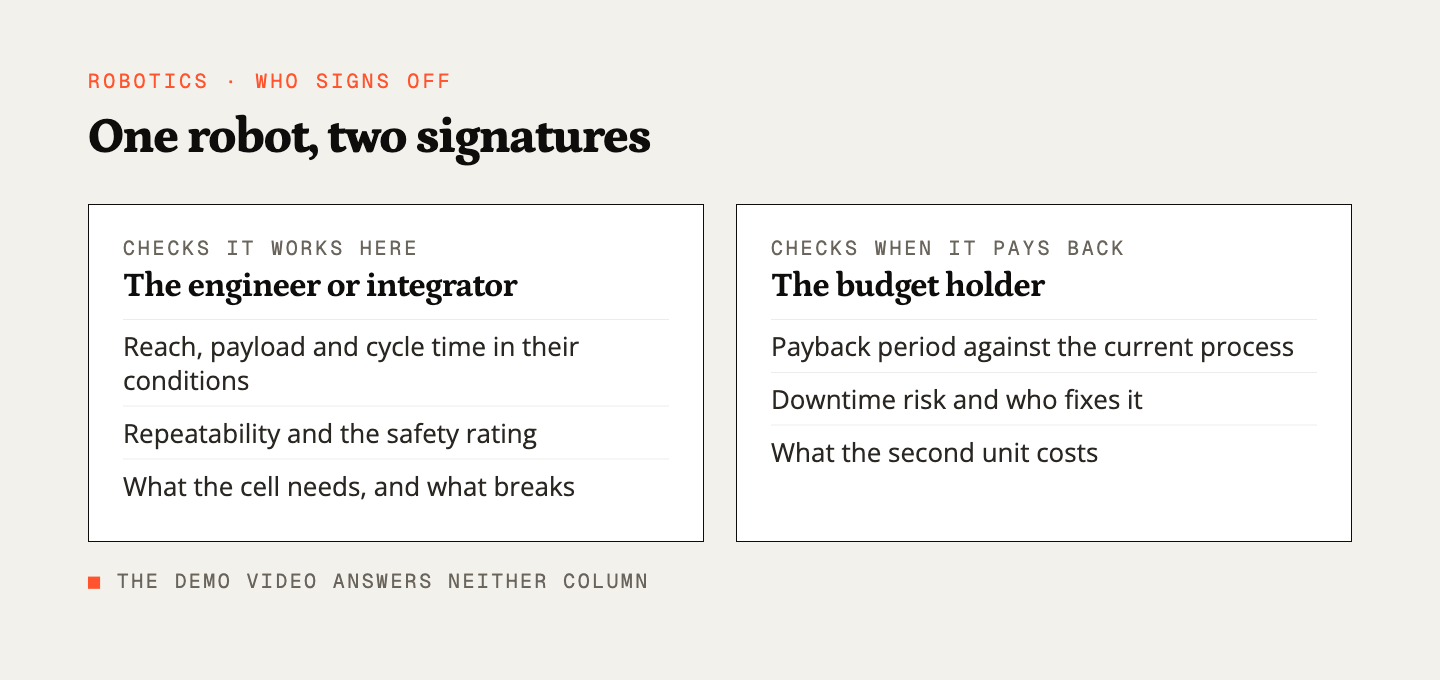
The engineer or integrator checks reach, payload, cycle time, repeatability and the safety rating, in their own conditions. The standards behind those checks are ISO 10218 and ISO/TS 15066, adopted in the US as ANSI/RIA R15.06 and RIA TR 606.
The budget holder checks the payback period, the downtime risk, and what the second unit costs. They also ask what happens to the people doing the task today. Firm-level Census data analysed in an NBER study found automation adopters raised skill requirements, with "limited or ambiguous effects" on their employment levels.
A brand written only for the engineer reads as a datasheet and never gets approved. Written only for the budget holder, it reads as a pitch and stalls in technical review. Decide which part of the site serves which reader, deliberately.
What replaces the demo video at the centre of the story?
The job replaces the demo video at the centre of the story.
The strongest robotics positioning describes the task being taken over and what changes once it is.
The shift stops depending on who turned up. The process runs the same at 2am. The operation can be quoted with confidence.
GenRobotics Medical, whose website we built, is listed on our customers page this way: "Robotics for sanitation work, so that clearing a manhole no longer means sending a person into it." The sentence names the job before the machine.
The same framing survives a product line. A brand built around one arm needs rebuilding when the mobile platform ships, and a brand built around the job does not.
Sevenloop describes build-to-print parts by stage, which is the job, and leaves the machines underneath. If you need film to show the task, our explainer video work starts from the same place.
How do you talk about autonomy without losing the technical buyer?
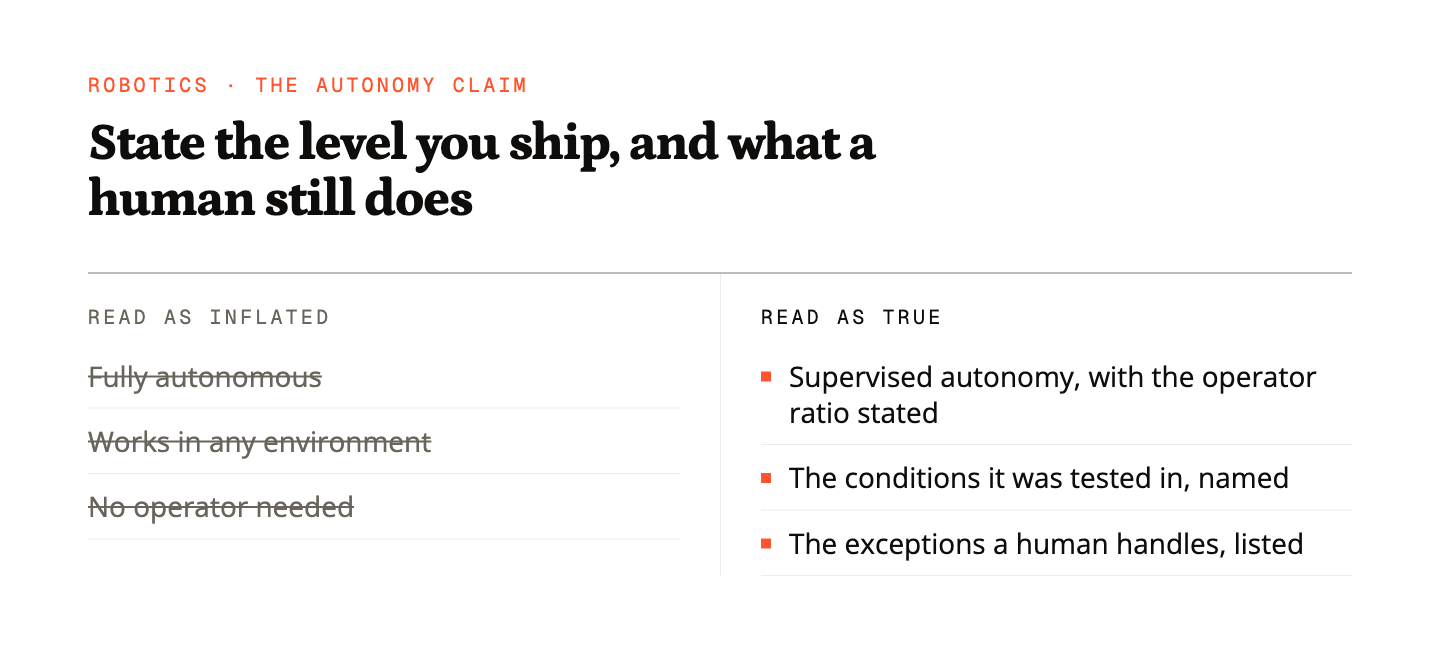
State the autonomy level you actually ship, and say what a human still does.
Autonomy is where this category loses credibility fastest. Buyers have been oversold before, so they read every claim as inflated by one level. "Supervised autonomy, one operator to eight units, human handles exceptions" persuades more than "fully autonomous", and it will still be true during the pilot.
Regulation is moving the same way. The EU's Machinery Regulation applies from 20 January 2027 and includes provisions for machinery with AI-powered safety functions.
NIST's collaborative robot programme is building test methods to show robot teams "complete their assigned tasks safely and correctly." Autonomy claims are becoming things a regulator or a test method can check.
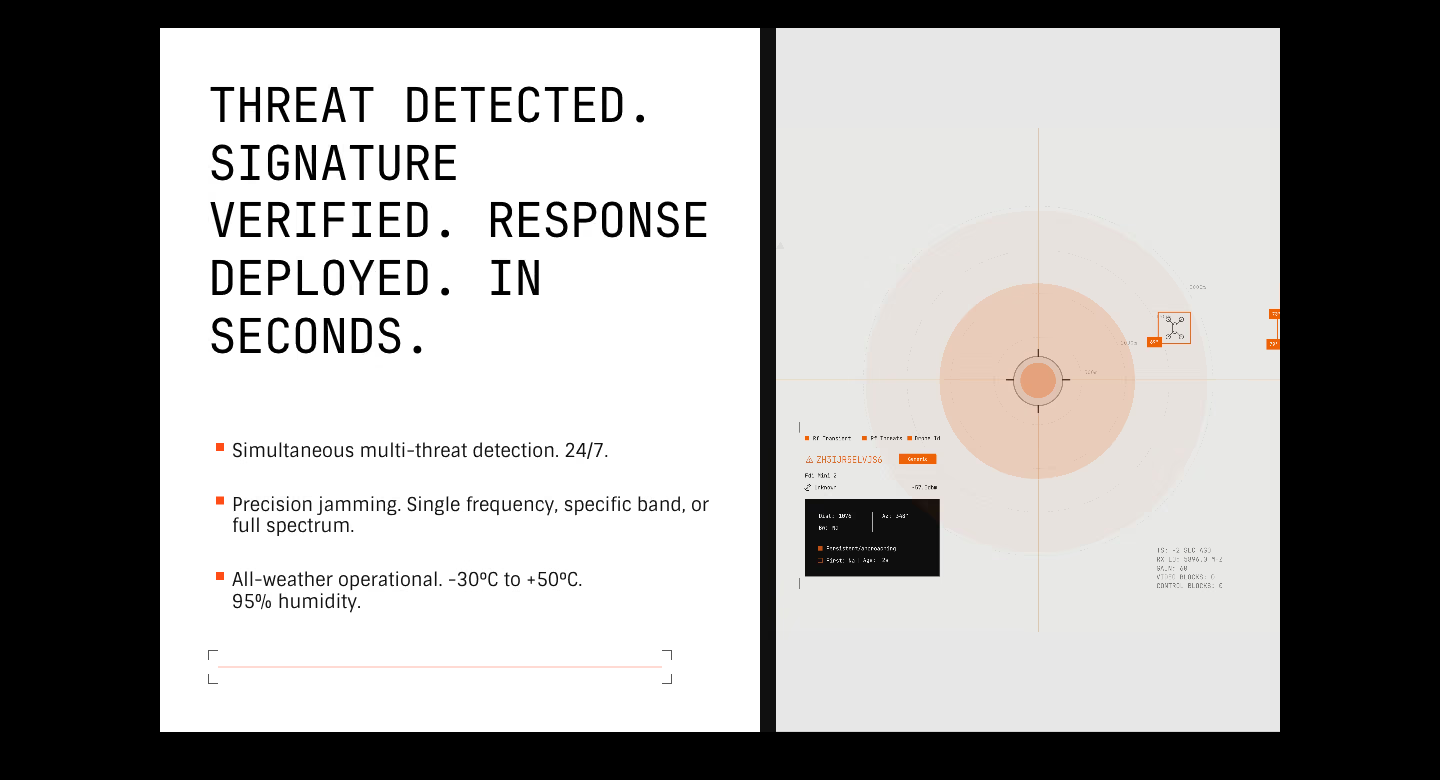
Armory shows the pattern from a neighbouring sector. Its site sets out detection, verification and response as a sequence, so the reader can see what the system does at each step. Overclaiming costs you the pilot, which is where the revenue was.
How should integration cost show up in the brand?
Integration cost should show up openly, and early.
Every serious buyer models integration cost whether you mention it or not. Left to the sales call, the number arrives late and unframed, after they liked the robot.
A realistic deployment picture in the brand covers three things:
- What a typical installation involves.
- What it needs from the buyer's team.
- What the timeline looks like, from site survey to steady output.
Safety belongs in that picture. OSHA notes that many robot accidents happen during "programming, maintenance, testing, setup, or adjustment", much of which falls in the installation period.
Stating how you handle it disqualifies the deals that were never going to close. It also makes you the vendor who was straight with everyone.
What does naming look like in robotics?
A robotics name has to survive being said on a factory floor, printed on a machine and typed into a purchase order.
Decide early whether the company name and the product name are the same thing.
Robotics companies often outgrow the first machine. A company named after it spends years explaining that it does more now. Our naming work settles that split before the second product exists.
What does a robotics brand need that a software brand does not?
A robotics brand needs a credible answer about service.
Software buyers assume support. Hardware buyers assume failure, and they are right: the machine will need a part, an engineer and a spare.
For a buyer putting a robot on a production line, three answers belong on the page:
- response time, stated as a number
- spares availability, by region
- who actually turns up, yours or a partner's
Most robotics sites treat all three as a footer link. The buyer treats them as part of the purchase. Where the site itself needs rebuilding around them, that is our robotics website work.
When should a robotics company invest in brand?
Invest in brand when pilots convert more slowly than the technology deserves.
Before a working deployment, it is early, because the story keeps changing with the product. The signal is a pattern in lost deals: the buyer understood the robot and still did not buy. Sometimes they understood it too late, and a slower competitor got there first.
That pattern is a positioning problem, and positioning is where the work starts.
Our guide to deep tech branding by stage covers what each stage can carry. The market is large enough that this pattern repeats: the IFR's robot density report puts the global average at 132 robots per 10,000 manufacturing employees in 2024.
What does an engagement deliver, and how long does it take?
A robotics brand engagement takes nine to sixteen weeks from kickoff to a finished brand system, at a fixed scope and one price. The price is quoted after a thirty-minute call, and the ranges are on our pricing page.
The work runs in this order:
- Category and positioning: robot, platform or automated service.
- Naming, where the company and product names need to separate.
- Narrative and identity.
- Messaging for the engineer, the integrator and the budget holder.
- A brand book that records all of it.
The team is nineteen people, ten of them engineers by degree, across strategy, 3D, delivery and build. Robotics often sits next to physical AI and advanced manufacturing, and we cover both.
Written by Mejo Kuriachan. More in the blog, the glossary and the FAQ.